The Bureau of Indian Standards (BIS) plays a vital role in protecting consumers by ensuring that products sold in India meet defined safety, quality, and performance standards. To achieve this, BIS operates multiple conformity assessment schemes. Among them, Scheme X Certification and Domestic BIS (ISI) Certification are two important frameworks that often cause confusion for manufacturers.
Although both certifications are issued by BIS, they are not interchangeable. Each scheme applies to different product categories, risk levels, and compliance requirements. Understanding these differences is essential to avoid regulatory delays and ensure smooth market entry.
This guide breaks down the key distinctions between Scheme X and Domestic BIS (ISI) Certification, helping manufacturers identify the right certification route for their products.
What is Domestic BIS (ISI) Certification?
Domestic BIS Certification, commonly referred to as ISI Certification, is a mandatory requirement for Indian manufacturers whose products are covered under Quality Control Orders (QCOs) issued by the Government of India.
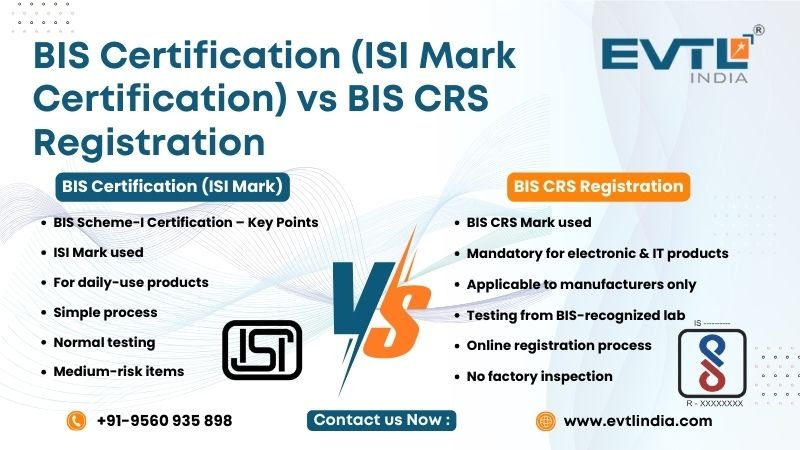
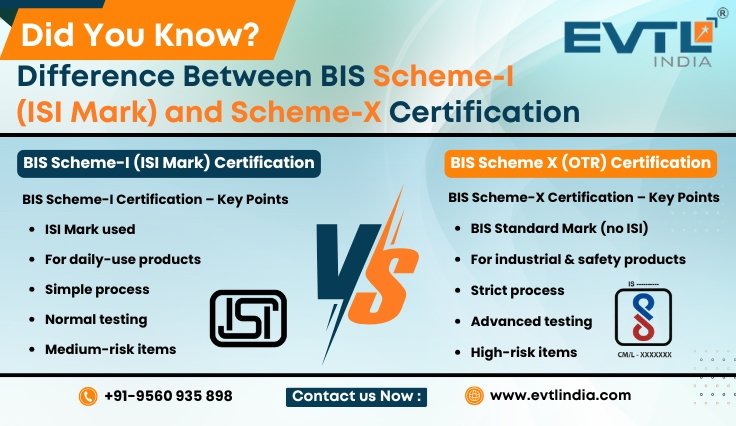
Under this scheme, manufacturers must demonstrate that their products comply with the relevant Indian Standards (IS) through testing and factory evaluation. Once approved, they are permitted to use the ISI Mark, a symbol widely recognized for safety and quality in the Indian market.
Key Features of ISI Certification:
- Applicable only to domestic manufacturers.
- Mandatory for products notified under BIS QCOs.
- Includes product testing, factory inspection and regular surveillance.
- Products carry the ISI mark, building consumer trust and market credibility.
Products commonly covered under ISI Certification include electrical appliances, cement, steel products, household goods, and construction materials.
What is BIS Scheme X Certification?
Scheme X Certification is a specialized BIS conformity assessment scheme designed for high-risk and safety-critical products. These are products where failure could lead to serious safety hazards, environmental damage, or infrastructure-related risks.
Unlike standard ISI certification, Scheme X involves deeper technical scrutiny. It places strong emphasis on design evaluation, risk analysis, and continuous compliance, making it a more rigorous certification pathway.
Key Features of Scheme X Certification
- Applicable to both domestic and foreign manufacturers
- Intended for critical and high-safety products
- Requires design approval, type testing, and periodic audits
- Focuses on traceability, consistency, and lifecycle compliance.
Scheme X is commonly applied to products related to infrastructure projects, power equipment, industrial safety systems, and other categories specifically notified by BIS.
Scheme X vs Domestic BIS (ISI) Certification: Key Differences
| Parameter | Scheme X Certification | Domestic BIS (ISI) Certification |
| Applicability | Domestic & foreign manufacturers | Domestic manufacturers only |
| Product Risk Level | High-risk and critical products | General consumer and industrial products |
| Certification Approach | Design approval with ongoing surveillance | Product testing and factory inspection |
| Marking | BIS Standard Mark under Scheme X | ISI Mark |
| Compliance Complexity | High | Moderate |
| Surveillance | Strict and periodic audits | Routine surveillance inspections |
Which Certification Should You Choose?
Choosing between Scheme X and ISI Certification depends on several factors, including:
- The product category notified under BIS regulations
- The safety and risk profile of the product
- Whether manufacturing is domestic or international
- Applicable Quality Control Orders (QCOs)
If your product falls under a Scheme X–notified category, ISI certification alone will not meet compliance requirements. On the other hand, most standard consumer products require Domestic BIS (ISI) Certification rather than Scheme X.
Why Consultants Matter
BIS certification involves detailed procedures, technical documentation, testing coordination, and regulatory interpretation. Experienced consultants help manufacturers understand applicable standards, prepare error-free documentation, manage testing and inspections, and avoid costly delays. Their expertise ensures faster approvals, regulatory clarity, and a smoother certification journey—allowing businesses to stay focused on production and growth.
Conclusion
Although Scheme X Certification and Domestic BIS (ISI) Certification are issued by the same authority, they differ significantly in scope, complexity, and application. Understanding these differences is critical for manufacturers seeking lawful market access, safety compliance, and long-term business success in India. Selecting the right BIS certification not only ensures regulatory compliance but also enhances brand reputation and customer confidence.