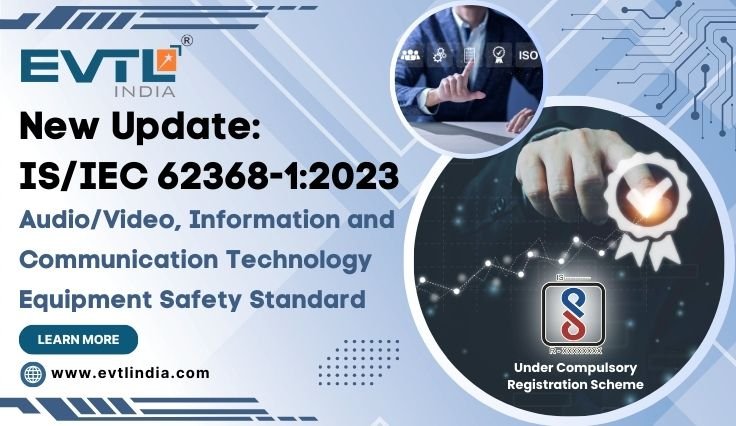
In a major step toward strengthening product safety and aligning with global regulations, the Government of India has adopted the international safety standard IS/IEC 62368-1:2023 for electronic and information technology equipment. This move represents a significant shift in India’s regulatory framework, replacing older safety standards with a modern, unified approach that better reflects today’s technologies and consumer safety expectations.
By adopting IS/IEC 62368-1, India joins many other countries that have already transitioned to this international standard, ensuring safer products, simplified compliance, and improved global market compatibility.
What Is IS/IEC 62368-1:2023?
IS/IEC 62368-1:2023 is a safety standard that specifies the safety requirements for audio/video, information, and communication technology equipment. Unlike the older standards it replaces, IS/IEC 62368-1 uses a hazard based approach to safety, focusing on identifying potential energy related hazards in electronic devices and ensuring appropriate safeguards to protect users.
This standard was developed by the International Electrotechnical Commission (IEC) and reflects modern design and technology trends. It has been widely adopted in global markets because it integrates safety criteria for a broad range of electronic products including traditional IT and AV equipment, and newer categories like battery-powered devices and Internet of Things (IoT) gadgets.
In India, the Bureau of Indian Standards (BIS) has published IS/IEC 62368-1:2023 titled “Audio/Video, Information and Communication Technology Equipment – Part 1 Safety Requirements”.
Why India Is Migrating to IS/IEC 62368-1
The decision to migrate to IS/IEC 62368-1 is driven by several key factors:
- Unification of Standards: Previously, safety requirements for electronic products in India were governed by two separate standards IS 13252 (Part 1):2010 for information technology equipment and IS 616:2017 for audio/video devices. These standards originated from older international norms (IEC 60950-1 and IEC 60065), which have been phased out in many regions. The new IS/IEC 62368-1 combines safety requirements into one unified standard, simplifying compliance.
- Alignment With International Best Practices: Global markets have largely moved to the IEC 62368-1 series due to its flexibility and modern hazard-based methodology. By harmonizing with this global standard, India enhances the compatibility of its safety framework with international norms, supporting easier global market access for manufacturers.
- Future-Ready Safety Framework: The hazard-based approach of IS/IEC 62368-1 is better suited to handle emerging technologies such as IoT devices, wearable tech, and extended reality systems because it assesses and mitigates energy related risks irrespective of specific product categories. This makes the standard robust and scalable for future innovations.
Migration Timeline in India
The migration to IS/IEC 62368-1:2023 is being implemented in a phased manner, giving industry stakeholders time to adapt:
- Extended Reality (XR) Products: The new standard now includes Extended Reality (XR) products such as Augmented Reality (AR), Virtual Reality (VR), and Mixed Reality (MR) devices. These devices have specific deadlines due to their emergent nature. Manufacturers and importers of XR products must comply with IS/IEC 62368-1:2023 by 1 May 2026.
- All Other Covered Products: For other electronics covered under the BIS Compulsory Registration Order (CRO)—such as computers, smartphones, audio/video equipment, and communication devices—the transition deadline is 1 November 2028. During the transition period, older standards (IS 13252 and IS 616) remain valid alongside IS/IEC 62368-1:2023.
- Withdrawal of Old Standards: After the transition period ends on 1 November 2028, IS 13252 (Part 1) and IS 616:2017 will be formally withdrawn and no longer accepted for compliance under the BIS scheme.
Impact on Manufacturers and Importers
The adoption of IS/IEC 62368-1:2023 affects all companies that manufacture, import, supply, or sell applicable electronic products in India:
- Compliance and BIS Certification: Products covered by the Compulsory Registration Scheme (CRS) must meet the new safety requirements and obtain BIS registration under IS/IEC 62368-1:2023. This involves product testing, technical documentation, and sometimes factory inspections to ensure conformity.
- Design and Engineering Considerations: Manufacturers need to design products with hazard-based safety engineering in mind, identifying potential sources of energy that could cause harm and incorporating appropriate safeguards. This may require modifications to existing designs that were originally compliant with the older standards.
- Market Readiness: Companies should begin planning their transition strategies as early as possible. This includes updating product specifications, testing procedures, and compliance documentation well before the respective deadlines. Early planning helps avoid delays in certification and market access.
Benefits of IS/IEC 62368-1
The migration to IS/IEC 62368-1 presents several advantages:
- Improved Safety: A hazard-based methodology ensures better protection for users against a broad range of risks.
- Simplified Compliance: One unified standard eliminates overlaps and conflicting requirements.
- Global Harmonization: With India aligning to an international standard, manufacturers can leverage the same safety framework in multiple markets.
- Support for Emerging Technologies: The standard’s structure accommodates modern and future device categories.