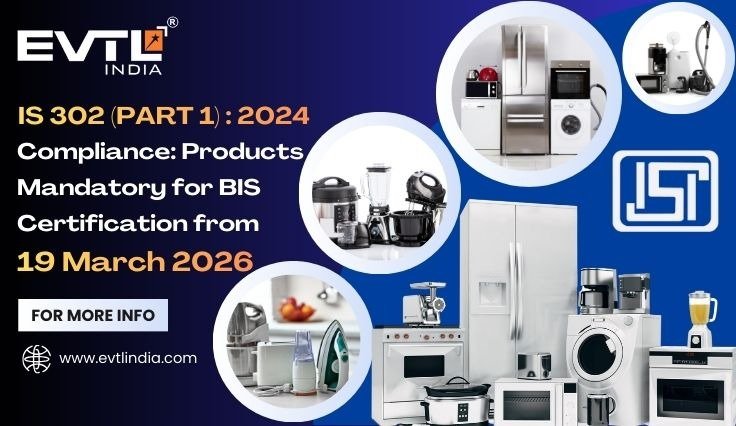
The Bureau of Indian Standards (BIS) has announced an important update regarding the transition from the existing safety standard IS 302-1:2008 to the revised IS 302 (Part 1): 2024, which is aligned with IEC 60335-1:2020. As part of this update, BIS has extended the concurrent running period the phase during which both the old and new standards can be used side by side for certification.
This extension brings much needed relief to manufacturers, importers, and other stakeholders in the electrical appliance sector, allowing them more time to adapt to the revised safety requirements without disrupting business operations.
What Is IS 302 (Part 1): 2024?
IS 302 (Part 1): 2024 is the updated Indian safety standard for household and similar electrical appliances. Harmonized with international IEC requirements, it defines general safety guidelines designed to protect users from risks such as electric shock, overheating, fire hazards, and mechanical failure.
The standard applies to a wide range of everyday electrical products, including adapters, heaters, kettles, cooking appliances, and other similar equipment. By aligning Indian regulations with global safety benchmarks, the revised standard improves overall product safety, quality, and international acceptance.
Why the Concurrent Running Period Matters
When a standard is revised, BIS typically allows an overlap or concurrent running period where both the old and new standards are recognized for certification purposes. This window provides manufacturers with time to:- Update product designs and documentation
- Conduct requisite testing under the new standard
- Prepare quality systems and factory processes for compliance
- Avoid supply chain disruptions
Without an adequate transition period, many manufacturers especially small and medium enterprises could struggle to meet suddenly imposed requirements, potentially leading to certification delays or market access issues.
The Extension: What’s Changed?
Originally, the concurrent running period for IS 302-1: 2008 and the revised IS 302 (Part 1): 2024 standard was expected to end on 23 February 2025. However, in an official notification dated 29 November 2024, the BIS extended this period to 23 February 2026. During this time, manufacturers can certify products under either the old or new standard. This extension reflects BIS’s commitment to realistic transition timelines and addresses industry feedback asking for more time to adapt to the updated safety norms.Key Impacts for Manufacturers
- More Time to Transition: The extended deadline gives manufacturers a full extra year to transition production and compliance frameworks to the new safety standard without immediate disruption. This is especially beneficial for those with complex product lines or where extensive redesign and testing are required.
- Dual Certification Option: Until 23 February 2026, companies may seek BIS certification under either the 2008 or the 2024 standard. This flexibility can be used strategically for example:
- Certify low-risk products under the old standard while preparing higher-risk models for the new one
- Phase in updated designs in stages
- Coordinate supplier testing across multiple product families
- Improved Product Safety and Global Competitiveness : Adopting IS 302 (Part 1): 2024 ahead of the deadline allows manufacturers to align with
international IEC 60335-1: 2020 safety criteria. This is an advantage for products targeting
export markets or global buyers who increasingly demand international compliance marks.
What Manufacturers Should Do Now
To make the most of the extended transition period and ensure uninterrupted compliance, manufacturers should take the following proactive steps:
- Understand the Revised Standard : Study the full requirements of IS 302 (Part 1): 2024/IEC 60335-1: 2020, especially areas where test parameters, performance criteria, or safety limits differ from the 2008 version. This may include changes in leakage current limits, temperature rise tests, and mechanical safety checks.
- Plan for Testing and Quality Adjustments : Identify internal processes and testing requirements that need updating. Arrange product testing with BIS recognized laboratories for any additional tests stipulated by the revised standard. Update quality manuals, technical files, and test records as part of certification applications.
- Finalize Certification Strategy : Decide which products will be certified under the new standard first and which can temporarily remain under the old standard during the transition period. Consider supply chain impacts, customer expectations, and market timing.
- Document Compliance and Undertakings : For existing licenses moving to the revised standard, manufacturers may need to submit updated test reports and undertakings confirming implementation of the new requirements. Work closely with your BIS branch office to understand specific submission requirements.
Key Takeaways
- Concurrent running period extended to 23 February 2026, giving manufacturers more time to align with IS 302 (Part 1): 2024.
- Both IS 302-1: 2008 and the 2024 standard remain valid for certification until this date.
- Manufacturers should strategically plan testing, compliance updates, and certification submissions to avoid bottlenecks near the deadline.
- Early adoption of the revised standard enhances product safety and global market readiness.