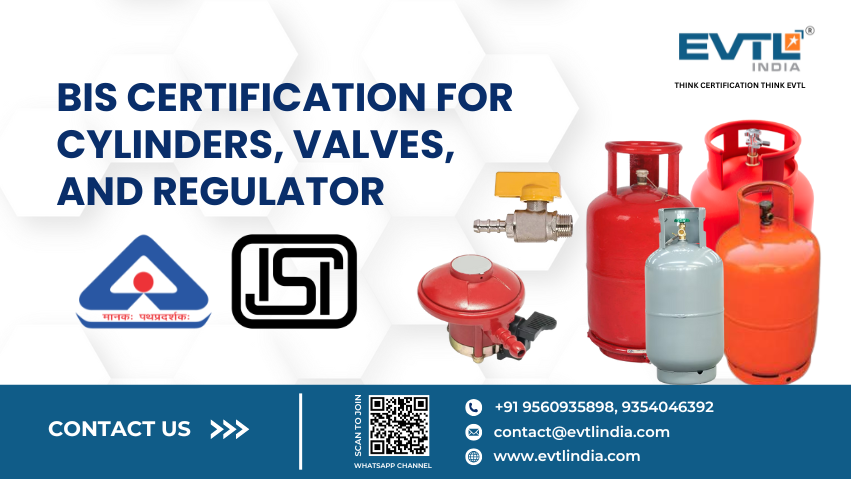
In industries where gases are stored,
transported, and utilized—such as domestic LPG distribution, medical
applications, automotive fuel systems, and industrial gas usage—cylinders, valves, and regulators play
a critical role in maintaining safety and operational efficiency. Given the
inherent risks associated with high-pressure gases and flammable or toxic
substances, ensuring the quality and performance of these components is
paramount. This is where the BIS ISI Certification becomes indispensable.
The Bureau of Indian Standards (BIS), India’s national standard body, has established detailed guidelines under various Indian Standards for the design, manufacturing, and testing of cylinders, valves, and regulators. Products that comply with these norms are awarded the ISI mark, a symbol of safety, reliability, and quality assurance.
Why BIS ISI Certification
Matters
The ISI certification is a
government-mandated mark of conformity for many products in India, and its
relevance is especially critical in sectors dealing with gas handling systems.
For cylinder valves and regulators, the ISI mark serves as a testament that the
product has met all the requisite safety
and quality benchmarks defined by BIS.
This certification helps manufacturers
align with national and international safety regulations while giving
end-users—both industrial and domestic—confidence in the safety, durability, and consistency of the product. It ensures that
the valves do not leak, the regulators maintain consistent pressure, and the cylinders
can withstand internal pressures and external conditions during their
lifecycle.
In a broader context, BIS certification supports India's mission to enhance product standardization, prevent accidents caused by substandard equipment, and promote the export readiness of Indian-manufactured components.
Overview of Applicable
Indian Standards
Several Indian Standards under BIS
govern the certification of cylinders, valves, and regulators, based on the
intended application and material specifications. These standards cover both metal and composite gas containers, different types of valves (including
medical, LPG, and industrial valves), and pressure regulators for liquefied and compressed gases.
Some of the key IS standards include:
Each of these standards defines strict criteria for material composition, wall thickness, welding integrity, valve operation, pressure limits, corrosion resistance, leak tightness, and more.
The Certification Process
Obtaining BIS ISI certification for
cylinders, valves, and regulators involves a systematic process that includes both product evaluation and
facility inspection. The goal is to verify not just the quality of the final
product, but also the consistency and control exercised during manufacturing.
Here’s how the process unfolds:
- Application Submission: Manufacturers must apply through the BIS online portal, providing product details, manufacturing information, and initial documentation.
- Product Testing: Samples are tested in BIS-recognized laboratories to confirm compliance with the relevant IS standard. Tests may include hydrostatic pressure testing, endurance (cycle) tests, leak tests, tensile and impact strength, corrosion resistance, and dimensional accuracy.
- Factory Inspection: BIS officials visit the manufacturing site to examine the quality control systems, manufacturing process, testing capabilities, and infrastructure.
- License Granting: Once testing and inspection are satisfactorily completed, BIS grants a certification license allowing the use of the ISI mark on the product.
Documentation Required
To facilitate the certification
process, manufacturers must furnish a comprehensive set of documents, which
typically include:
These documents help BIS evaluate the manufacturer’s ability to consistently produce items that conform to standard specifications.
Certification Validity and
Renewal
A BIS ISI certification is generally
valid for two years, after which it
must be renewed. Manufacturers are eligible for renewal provided there are no
substantial changes in the design, materials, or production process of the
certified product. Regular audits and surveillance checks are conducted by BIS
to ensure continuous compliance throughout the validity period.
Renewing the license before its expiry is crucial to avoid any disruption in market operations or legal complications, especially for regulated goods like gas handling components.
Conclusion
In a sector where safety cannot be compromised, BIS ISI certification for cylinders,
valves, and regulators serves as a non-negotiable
requirement. It ensures that every component involved in the storage,
control, and delivery of gases adheres to the highest standards of performance
and safety.
Whether for domestic LPG use,
industrial applications, or life-saving medical equipment, certified gas
systems instill trust and protect both property and human life. For
manufacturers, it opens up access to national and international markets, builds
brand credibility, and ensures legal compliance.
As India's regulatory framework
continues to strengthen around product safety and standardization, BIS ISI
certification remains a critical factor for manufacturers, importers, and
consumers alike.